Showing posts with label Japanese patterns. Show all posts

Saturday, 25 April 2020

She Wears the Pants no. 15: Draped Cardigan

After I made no. 12, the draped minidress, I was less secure about my choice to size up to a M for this cardigan as well, but I forged ahead. My waist and hip measurements are M but my bust is S, so in this cardi I thought it was meaningful that it fit well about the hips.

The fabric is a drapey merino and tencel blend. It's a beautiful fabric, but it's relatively heavy and has quite a lot of drape for a loopback knit.

The pattern - I found it hilarious and so much fun to make!  It comes together really quickly and there's just nothing quite like Japanese patterns, I mean, the entire body is one single piece.

What I did determine: you should pull tension on the neckline binding between the shoulder seams, and then pull NO tension on it for the rest of the length of the cardigan. I pulled a little bit on it the whole way along, and I find the neckline is too loose, and the cardigan pulls inward because of my binding.


AND it's very big.  I like the sleeves a lot.  But the whole cardigan goes halfway to my knees!  Those models might possibly be really tall, but also my knit is heavy and has a tendency to pull downwards.


I'm happy about this result, but also disappointed, and I had to pause and remind myself that just lately I was confirming the need to make something multiple times before you get it right.  I'm not going to bother with buttons this time around - I had thought about interfacing the button part of the band, which would be wise if you can figure out which part it is!  It doesn't need to be stretched so the interfacing won't interfere that way - I would definitely interface in future, especially on a lighter knit.

There's nothing in my stash that works for this, but I definitely want to try again. I've been doing a lot of Alabama Chanin experimentation, and actually I think this might work perfectly with 2 layers of overlock cotton - they aren't very stretchy, but the two layers creates a substantial result.  There's room for improvement.  (I don't think I'll size down until I've tried a different fabric first.)

Friday, 24 April 2020

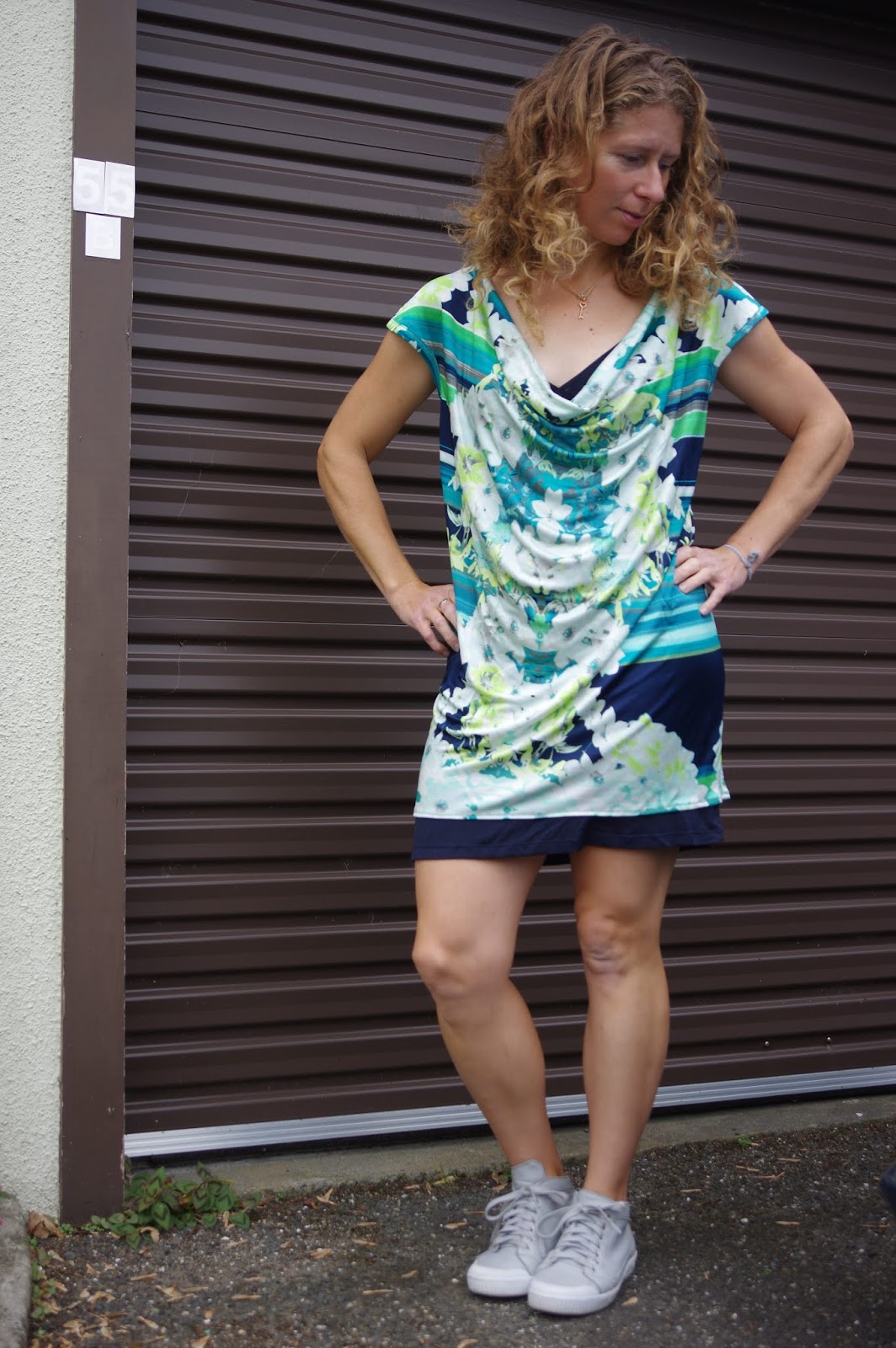
She Wears the Pants no. 12: draped minidress

I was allowing myself to thumb through my Japanese pattern books for inspiration...and sure enough, inspiration was waiting for me in She Wears the Pants, by Yuko Takada.

I picked out no. 12: the draped minidress, realising I have exactly the fabric for it, and I was enticed by how simple it was, but also how clever - the grainline isn't at the centre of the front piece, presumably to alter the drape of the front.

Problem: my chest is 32.5, which is a small, but my waist and hip are solidly a size M.  I decided to size up, and I sincerely regretted that later - I didn't think through silk jersey, and how it would be better for it to be too small, and very clingy, rather than too big.

I sort of went my own way with the bindings doing a kind of hybrid bias binding on them, but otherwise the pattern was very simple.  Tracing the pattern, I thought about my previous experience trying to copy a Japanese dress (here) and how a very simple appearing decision like an offset grainline can make all the difference to the pattern.

You only trace 2 pieces. You measure your own bindings, and you mirror imagine the front piece to create 2, whereas the back is cut on the fold.  It was one of the simplest Japanese patterns I've ever traced out.  Of course adding seam allowances, a minor irritation.

Though my jersey was slippery, overall this is a very easy sew.
It's just like the model! Even the weird, hunched over look!  In my pictures I promise I'm not hunching. I do have a blue dress under it which shows at the hem (obviously and at the chest).


Not hunched over, for real!


You see I really should have sized down.  A size down would have indeed been clingy, not a bad thing in this fabric, and it also wouldn't have draped down to my belly button.  It may not quite show my belly button but I look down and see a lot so it feels like it exposes more than it does!   The weight of the drape comes directly from the shoulders so the bindings are a good support.  I really like how nicely finished this is, and how easily it came together.


As it is I'm happy with this experiment. I wore it to dinner at friends (they are part of my shared isolation bubble, no judging!) and layered a bra top under it and it was great. Also, looking over the book again the model is wearing a top under it so possibly it drapes down to her belly button too.

Thoughts:
size down if you are in between, especially in a heavier weight fabric
the front drape flips inside out at times, so a fabric that doesn't have an obvious reverse side is better.
easy dress! 

Tuesday, 11 February 2020

Shape shape 2 double layer skirt in silk

My library had a copy of Shape Shape which I took home to peruse. I've been on a mission to make a poufy double or triple layer silk skirt and I recently acquired three colours of silk.  I was initially going to do a gathered skirt in three layers, but this caught my fancy instead.

I prepped a size small despite being worried that it will be too narrow in the hips.  The measurement is only off by 1" from my measurements, but I thought Japanese patterns tend to be really tiny.  I expect to make an M in Japanese patterns, not a small.

Ugh adding seam allowances.  But the pattern is only two pieces so I guess I shouldn't fuss too much.  It uses 2 separate rows of narrow elastic instead of a single wider elastic, which I thought was interesting.  Basically in the end you have 4 separate pieces of elastic around your waist. (Good? Bad? I'm actually thinking not very good.)

I used two of my three silks: silk organza in a very light gold colour, and brown crinkled silk, heavier than chiffon weight.  Because both are relatively transparent I did french seams on the sides and on the bottom where the two fabrics connect.

This turned into an exercise in imprecision. The crinkle silk was crinkled when I cut it, but obviously stretched when sewn.  I ended up with this:


I cut off that edge!

I overlocked the waistband before folding it over, and because of my french seams I then did the two waistbands separately, folding the waist over enough to hold both, but sewing down the top one, inserting the elastic, and then sewing down the second one.  The organza could have done with a tighter fit - the elastic slips around in the casing and it does rotate.  Since there are 4 elastics which are all slipping and twisting separately, the waistband isn't that comfortable.


End result: The waistbands bother me a little, but the concept of the skirt is still pretty fun. I can wear it in four ways - I think twisted looks more interesting than straight, and time will tell if the waistbands shift around a lot with movement/life/walking.


It's hard to tell if my fabrics make the skirt large, but it's definitely big enough.  The small was fine. The crinkle silk obviously stretches a LOT, and I will admit I cut out the organza without many pins (which is still more than usual!) ...so it might have shifted.

This would be fun to make in voile, and I think fabric that doesn't need french seams is better - you can use the technique in the instructions for the waist elastic, which will lead to it being tighter and not twisting as much.


Wednesday, 18 September 2019

Szeki 7115 & the Japanese dress

Otherwise known as Japanese pattern-copy-hell.

We all know from Japanese pattern books that the pattern pieces are deceptively simple.  A few pleats here, a slight angle there, and a pattern piece which is functionally a big square turns into an amazing, truly ingeniously draped work of art.

Despite which, when one of my work colleagues offered to let me borrow this nice dress from the pattern designer Szeki, I said yes with enthusiasm instead of with foreboding.  The dress was still on the website as the "kimono dress" in another colour, though I believe the one I was borrowing is a few seasons old.

Here is the original dress that I'm trying to copy.


The fabric is a blend of linen and viscose which gives it a lot of weight, a certain crispness, but also luxurious drape.  I had to search to find a similar fabric, which I got from Germany on Etsy. The seller has vanished, but the fabric is great - it was about 50/50 tencel and linen with a slubbed texture - just what I wanted.

In the meantime I had some cotton that I had bought in preparation for this pattern, just plain lawn.  However what happened is that I tried to trace the dress onto paper, and something in the middle was getting lost.  This dress is 2 copies of one just about rectangular pattern piece, with a mid front seam and a mid back seam.  There's a shoulder seam that creates the armholes.  So simple...yet not.

I could not properly capture the curve at the shoulder.
I had to cave in and use my fabric to make a muslin.  I basically pinned it onto the dress and cut around it and then copied my "muslin" and basted the two pieces together.  Then I laid the dress over it and tried to figure out what I'd done wrong.

The complexity was compounded because both the front and the back are V shapes, and I kept mixing them up.

I was excited and so I bought some fabric in the interim, from Miss Maude.  It's the viscose by Atelier Brunette so it's still luxury expensive stuff, but much lighter and floatier than the Japanese dress.

After the muslin, I traced that fabric onto a piece of tracing paper, lined *that one* up with the dress again, and finally decided it was as good as I could get.  I cut out my first attempt.  Here you go:


I had planned to make it shorter than the original anyway, but I only ordered 2 metres of fabric so I ended up also not having enough for the full length.  I reshaped the hem after cutting, to try to approach the semi-tulip of the original, and probably overdid it.  I just overlocked everything because I had little faith in my final outcome.  

On my version the shoulders sit a bit further forward and I originally thought I had it way off.  I realised after some tugging that the weight of this dress does not pull it backwards enough, but that my v shapes were close to the original - the back V is a bit smaller.  My armholes are much bigger. 

I modified the pattern after this, taking a strip out of the pattern piece that would functionally decrease volume and decrease how big the sleeve opening was.  I didn't change the V neck.

And finally in the viscose-linen:


I felt very frustrated at the end of all this and glad to be done with it.  My second copy mimics the original with all french seams on the inside.  It doesn't feel the same as the original when I have it on, but I was really surprised by my photos.  They look so similar!

This experience was hard!  I'm going to be even more appreciative of complex yet simple patterns, especially Japanese ones, after this.  The original dress & the identical copy go back to the owner, but I'm keeping the viscose version for myself.  I think it'll do as a summer dress.